Research Journal Panel & Market Jurisprudence Updates

The Judicial Economist

From Equality to Equilibrium

Is payment of fine for belated payment of excise duty allowable u/s 37(1) of Income Tax Act? Discussion with accordance to CIT Vs. Hoshiari lal Kewal Krisan case


Background of the case

Owners of businesses can avail deductions from their
income in respect of certain expenses. However, expenses incurred by an
assessee for any purpose which is an offense or which is prohibited by law
shall not be deemed to have been incurred for the purpose of business or
profession and no deduction or allowance shall be made in respect of such
expenditure. In the case of CIT Vs.
Hoshiari Lal Kewal Krisan
, the assessee (Hoshiari Lal Kewal Krisan) claimed
a deduction of Rs. 31,433 in respect of the payment of fine for belated payment
of excise duty installments. The Assessing Officer (AO) and the appellate
authority disallowed the expense, however, the Tribunal allowed it.


Issue

The issue of the case was to examine if the fine paid
for belated payment of excise duty is allowable business expenditure.  

Rules

In order to reach a conclusion regarding the
aforementioned matter, we need to know the provisions of section 37 of the
Income tax Act 1961 (hereinafter the act).

As per section 37 of the act, any expense, not being
expenditure of the nature described in sections 30 to 36 comes under the
head of this section. However, the personal expense of the assessee and the
capital expenses are to be excluded from the periphery of section 37. In this
context, it is important to note that the expenditures that have been incurred
wholly or exclusively for the purpose of the business or profession can only be
claimed for deduction under section 37 of the act. Another condition for
claiming a deduction under this section is that the expenditures should have
been incurred in the previous year.

In Prakash Cotton Mills Pvt. Ltd. Vs.CIT (1993), it was held by the Supreme Court held
that the payment of statutory impost by an assessee by way of penalty, damage
or interest is to be claimed as allowable income under section 37(1) of the
Income Tax Act 1961. Therefore, the assessing authority is to examine the provision
of the statute providing for payment of such impost. Payment of impost in the
nature of punishment is to be treated under the stated act; however, payment of
impost as compensation is to be allowed under section 37(1) of the act. 

Application

In the given case, High Court observed that the payment of fine for belated payment of exercise duty is statutory impost. Therefore, the concerned impost is purely compensatory in nature. In other words, it can be stated that the payment of a fine is not a punishment, but a compensatory payment.   

Conclusion

In the discussed case, it was held by the High Court
that although the payment is termed as fine; however, the nature is
compensatory. Hence, the assessee has the right to claim such an expense as an allowable expense under section 37(1) of the Income Tax Act 1961. 


Bibliography 


 Indiankanoon.org 

THE ROLE OF NATIONAL HUMAN RIGHTS COMMISSIONS OF INDIA AND THE PROCEDURES OF LODGING COMPLAINTS


THE ROLE OF NATIONAL HUMAN RIGHTS COMMISSIONS OF INDIA

After the Second World War the
concept of “human rights'' was introduced to international law. The
establishment of the United Nations also played a major role. The General
Assembly of the United Nations universally declared human rights on 10 December
1948. It was a definite milestone in the history of human rights. Every human
being has certain rights socially, politically or economically as long as he is
a human being. The UN commission adopted the guidelines on human rights which were
the “Paris Principles'' in 1992. The UN General Assembly then adopted it in
1993. The Paris principle was the centre where the development of national
human rights commissions from all over the globe took place. The National Human
Rights Commissions are independent autonomous bodies that act as a supporting
role to the already existing institutions.


Establishment of NHRC

The National Human Rights Commission
of India is an independent organisation that was established on 12 October
1993. In 1992 the (then)Prime Minister of India held a conference of Chief
minister’s where he put forward the
modalities to set up the Human Rights Commissions. The meeting explored the
issues of placing the constitutional rights of civil liberties within the
boundaries of the Commission and custodial justice. It was constituted under
the Protection of Human Rights Ordinance of 28 September 1993 which was enacted
by the Protection of Human
Rights Act, 1993. It was introduced to protect and promote human rights, which
are the basic fundamental rights relating to equality, liberty and dignity of
each and every human being guaranteed under the Constitution of India
regardless of their class, creed, sex, religion, language or any other status.


Power of NHRC

The National Human Rights Commission
holds certain power related to inquiries under Section 13 of the Protection of
the Human Rights Act. 1993.

       
The act gives NHRC the power to summon and enforce a witness
to examine them

       
It can discover or produce certain documents if need be

       
It can receive any evidence based on affidavits

       
It can formally request for any  public record or copy from any sector or
organisation

       
It can very well issue a Commission to examine a witness or
any documents whatsoever


The National Human Rights Commission
also holds certain power related to an investigation under Section 14 of the
Protection of the Human Rights Act, 1993.

       To conduct an investigation related to any inquiry, the
Commission may/can seek help from the investigating officer/organisation that
are/is working for the Central or the State Government.

       The assistance of the investigating officer or organisation
under subsection (1) who helped investigate in any matter related to the
inquiry will be subjected to the direct control and order of the Commission

       The clause of Section 15 will be applicable to any person
who has given a statement to the investigating officer/organisation. It will
also be applicable to any person who has given a statement while presenting any
evidence to the Commission.

       The investigating officer/agency whose assistance has been
utilised under subsection(1)  will
investigate the inquiry and submit a report to the Commission under a given
time period mentioned by the Commission itself

       The Commission will decide for itself the legitimacy of the
facts and conclusion (if any) provided in the submitted report under subsection
(4). The Commission may also make such inquiry again if need be.

Role of NHRC in establishing
human rights in India

The National Human Rights Commission
of India plays some major important functions in order to the successful
establishment of rights in India.

       It keeps a constant check on violations of any rights that
have been done by any government body, employee, or even by the government of
India itself.

       It reviews and gives solutions against all the acts which
include terrorism that violates the enjoyment of human rights.

       It promotes research under fields of human rights and
undertakes them as well.

       It recommends the effective implementation of the international
and national treaties related to human rights.

       It safeguards human rights and suggests ways for their
strong implementations.

       It also visits the prisoners and goes through their
condition and discusses their views.

       It promotes, engages, and spreads awareness among the
society on human rights education and availability of protection through
several means such as seminars, publications, and many more.

       It motivates the organizations that are working to protect
human rights in society.

       It also makes people aware of the necessity of human rights
in society.


PROCESS OF LODGING COMPLIANTS

In order to lodge or register
complaints, some steps need to be followed:

Step 1: Visit the official website
of NHRC or
www.nhrc.nic.in

Step 2: Click on Lodge
Complaint/Track Status Button

Step 3: Click on Lodge Complaint
Button

Step 4: A form will appear on the
screen which is needed to be filled

The form includes:

       Select state of Incident

       Location of where do you want to submit your complaint

       Provide your mobile number

       Provide your email ID

Step 5: An OTP will be sent to your
mobile number or email id

       All the above steps are mandatory verification, post this, a
detailed form will appear on the next screen.

       In the next form, you have to provide your name, gender,
address, state, district, and pin code. Victim details, which consist of name,
gender, address, state, district, pin code, disability, age, religion, and
caste also need to be provided.

       Details of the incident such as place, state, district,
date, category, sub-category, complaint description, and whether it has been
filed before any court or state human rights commission or not need to be
provided.

       After this, a relief details area such as name, designation,
and the address of the public servant with full details has to be given.

Step 6: Finalise the complaint by
clicking on the Preview

Step 7: If required, upload
documents in PDF format only.

Step 8: Choose if you want to
display the complainant and victim’s name on the website or not

Step 9: Click on Submit

A Unique Diary Number will be
provided after the successful submission of the complaint, which will be
helpful to keep track of the status of the complaint.

Recent Initiations made by NHRC of India

i) On the 29th of July, 2020, the NHRC
ordered the Telangana government to five lakh rupees in order to compensate the
families of five Muslims who were killed by the police force due to false
accusations of many terrorism charges,

ii) A suo-motu complaint filed by the NGO at NHRC, International Law Affiliates on
the favour of poor young girls in India and Nepal for being forcibly pushed
into prostitution after being trafficked, in many red-light areas.

iii) Once again a suo-motu complaint was filed against two miscreants in Karimpur,
Nadia, West Bengal for being allegedly raping a visually impaired girl at her
home in the absence of her parents.

iv) A boy was found dead in an observatory home in Karnataka. It was first
published in a national daily on 14 December 2004. The commission asked for a
report from the secretary of the state, 
which stated that the deceased was charged of theft and for which he
committed suicide,

v) NHRC investigated the case of Suraj Singh who was killed in an encounter at
Sultanpur, UP, in Feb 2007. The commission’s report states that the encounter was a
cover-up to justify the murder.

Every organization and body needs a statutory or a regulatory body to protect the rights of every individual. The Constitution

provides its citizens with numerous rights which will be violated if not
protected. Violation of human rights is equivalent to disrespecting the
Constitution of India and it is a punishable offence. The National Human Rights
Commission of India serves the country as an army. As the Indian Army is
protecting the citizens of this nation from the enemies, similarly the NHRC is
also protecting our human rights from the violators. 


BIBLIOGRAPHY

Nhrc.nic.in

One Person Company, a new horizon to the sole proprietors


One Person Company


The
concept of the Person Company is the outcome of the revolutionary changes in
the Corporate Laws as made by the Indian Parliament for modernizing the
business procedures of the corporate entities. Previously, the term “company”
was synonymous with the “association of individuals or persons”. This new concept of
One Person Company has changed the stated literal meaning of a company.


The
Law and the Concept:


Before
the enactment of the Companies Act 2013, there was no provision regarding the
formation of a company without having the prescribed number of members. The
minimum number of members required for forming a private limited company under
Companies Act 1956 was 2. However, under the new act, that is, the Companies
Act 2013, a company can be formed by a single member and such a company shall
be called as the One Person Company.


This
clearly shows that an OPC has only one shareholder or member. However, the
basic features of a company do not become extinct here. Keeping these
features, the assets and liabilities of an OPC is treated separately from the
assets and liabilities of its sole member. In other words, the OPC and its
member are different and this makes an OPC different from a sole proprietorship
business.


Features
of One Person Company


One
Person Company has some distinct features, which are discussed below.


1. One person: The
most striking feature of a One Person Company is that it has only one director
(S. 149 of the Companies Act 2013), who is the only shareholder of it.


2. Amount of minimum paid-up
capital:
The Companies Act 2013 specifies the minimum paid-up
capital for OPCs. An OPC shall have at least Rs. 1 lakh as paid-up capital.


3. Financial Statements: An
OPC requires to publish the Statement of Profit and Loss and Balance Sheet. Unlike
other companies, it does not need to publish the Cash Flow Statement. The sated
financial statements are required to be filed with the Registrar of Companies (RoC)
within 180 days from the date of closing of the financial year.


4. Writing the name of the company:
A
One Person Company needs to mention its name in brackets below the name of the
company.


5. Non-applicable clauses: The
following clauses are not applicable to an OPC:


  • Clause 98: Power of Tribunal to
    call meetings of members,

  • Clause 100: Calling of extraordinary
    general meeting,

  • Clause 101: Notice of Meeting,

  • Clause 102: Statement to be annexed
    to notice,

  • Clause 103: Quorum for meetings,

  • Clause 104: Chairman of meetings,

  • Clause 105: Proxies,

  • Clause 106: Restriction on voting
    rights,

  • Clause 107: Voting by show of
    hands,

  • Clause 108: Voting through
    Electronic means,

  • Clause 109: Demand for poll,

  • Clause 110: Postal Ballot,

  • Clause 111: Circulation of members’
    resolution


Why to prefer One Person Company
over a sole-proprietorship business?


 1.
Single entity:
In the case of One Person Company, the sole member and the
company are treated as separate entity.


2. Taxation: In
the case of sole proprietary business, the entire profit of a business is
treated as the income of the sole owner. However, the earnings of One Person
Company is not treated as the income of the sole director or member. The
concept of One Person Company was introduced through the Companies Act 2013,
and in the Income Tax Act, there is no special treatment regarding the income
of the One Person Company. Here, in this case, the profit of One Person Company
is treated as the profit of a company and treated according to the rule of
taxation of a private limited company. 


3. Succession: On
the occasion of the death of the sole director of an One Person Company, a designated
nominee can run the company. On the other hand, a sole proprietary firm gets dissolved
with the death of its sole owner.     


Steps involved in forming One
Person Company


Bibliography

1. Mca.gov.in


Groundwater depletion and its effect on River Ganges


What is the matter?


Researchers
have found that continuous withdrawal of groundwater through pumping depletes
the Gangetic aquifers in Northern India. However, Ganges is one of the mega-polluted
rivers globally. The water depletion during hot summer days poses a serious
threat. The surface plants, power generation units, face serious consequences
navigation along the rivers, irrigation systems, and agricultural units in our
country. A team of experts from IIT, Kharagpur, has done extensive work from
1999 to 2013. They have reported that the decrease in the groundwater level
flow imposed serious effects on the health of the rivers in India. According to
their study, the present base flow to the Ganges from the adjoining aquifers might
be a third or total of river water volume during the pre-monsoon days. Since
1970, the groundwater level has decreased by 50% due to the continuous pumping
up of the ground level water for irrigation purposes. If the extensive
withdrawal of groundwater continues then the day is not far when the Indo-Gangetic basin will get affected adversely which will decrease the food
production over time. Studies suggest that by 2050, carbohydrate-based food
will be unavailable in India for almost one-fifth of 500 million living in the
country
(Nature India. 2020).


Effects of Groundwater depletion


1.    Water well problems: As the depth to the
water will increase, water needs to be lifted higher to reach the land surface.
Soon it will not be economically feasible for the country to dig into the deep
level under the ground. The cost of lowering the level of pumps will be
required which will affect the livelihood of the people who are directly
dependent on the groundwater availability for earning and sustaining.


2.  Reduction in the surface water flow: It
is not unknown that the surface water flow and the groundwater level are
interlinked. Continuous depletion of groundwater will cause a lowering of the
depth of the surface water bodies and soon the aquifers will dry up.


3.  Deterioration of the water quality:
Naturally, there is a balance between the saltwater and freshwater boundaries,
due to the continuous depletion of the groundwater level can lead to the approach of the saltwater into the areas of freshwater bodies. The drying of
aquifers will result in absence of freshwater for animals and plants with
excess saline water in the environment.


Ways for protection and conservation of
Groundwater levels


1.     
Using native plants in the landscapes and
promoting afforestation will help in the conservation of the groundwater levels.


2.     Decrease in the use of chemical
pesticides in agricultural areas will help in maintaining the quality of
water. Directly, the chemicals have an adverse effect on the food chain of the
terrestrial and aquatic flora and fauna. The judicious use of chemicals will
help in the conservation of the quality of livelihood (Asoka
et al., 2017)
.


3.     
Prevention of irresponsible disposal of
hazardous chemicals will help in the conservation of the quality of the
groundwater.


4.     
People should stop wasting water in
houses, agricultural units, and industries. Today's conservation of water will
help us in sustaining in the coming future.


5.     
Reduction in use of freshwater and always
recycling and reusing water for multiple purposes wherever feasible.


References


Nature India. 2020. Groundwater Depletion Dries Up The Ganges In Summers. [online]
Available at: <
https://www.natureasia.com/en/nindia/article/10.1038/nindia.2018.121> [Accessed 16 December 2020].


Plastic Waste Crisis in Metropolitan Cities in India

The scenario:


According to reports, India
produces about 26,000 tons of plastic wastes every day, making our country the
15th biggest plastic polluter in the world. It is observed that Indian roads,
rivers, lakes, dumping areas have huge mounds of plastic wastes. During
monsoons, water logging occurs due to the plastic garbage accumulation in the
public places. The ugly sights of plastic bottles, bags, plates lying here and
there are common in different metropolitan cities in India. The waterlogged
places soon become the breeding places of mosquitoes. 


Beside the malodour, these
waterlogged places pose major health-hazard for the residents of the
surrounding areas due to the spread of the mosquito borne diseases.
Municipality authorities take up the responsibility of burning the solid wastes
accumulated over time, however this causes dense air pollution creating serious
health threats for the street dwelling animals like cats, dogs, buffalos and
even for near living residents, which is often suffocating and even fatal for
some.

Growth in plastic consumption
(Source: Downtoearth.org.in)

Taking this serious issue under consideration, Indian Government has
taken the initiative of promoting the single use of plastic bags publicly. In the
Parliament, Lok Sabha secretariat has ceased the use of non-reusable plastic
bottles and other plastic items. Railway premises are made with no plastic
zones, with vendors being encouraged to use usable plastic items to reduce the
plastic footprint. About 8% of solid plastic waste is produced by the capital
city Delhi, followed by other big cities like Kolkata, Ahmedabad. Out of the 25,940
tonnes of plastic wastes produced by India everyday, 94% is thermoplastic or
reusable items like PET (Polyethylene terephthalate), PVC (Polyvinyl chloride).
Materials like PET, PVC can be recycled easily 7-9 times after they are
disposed of. According to the CPCB reports, India recycles around 80.29% of
plastic wastes, collected by the army of rag pickers who collect and segregate
the waste materials. Merely 28.4% of the non-recyclable wastes are treated
before disposed of, while rest are left to pollute lands and water bodies. Here
is a brief study of the plastic waste crisis faced by different metropolitan
cities in India.


Delhi: According to a 2015 case study conducted by CPCB
(Central Pollution Control Board), Delhi topped the list with 690 tonnes of
daily plastic waste production followed by Chennai, Kolkata, and Mumbai. The
huge heap of the solid waste in the capital city is gaining enormous size day
by day. The dumps of Delhi are identified as the most hazardous, least
regulated in the world. In spite of having a huge workforce of garbage
collectors in action, Delhi still tops the list of largest solid waste producers
in India. Places like Bhalswa, Ghazipur and Okhla dumpsites in Delhi are
already overloaded. In July, National Green Tribunal sought compliance from
Delhi government with the tribunal’s December 3, 2018 in order to deposit 25
crore rupees with the Central Pollution Control Board (CPCB) for unregulated
plastic handling. The Government is directed to deposit the money as
compensation for causing the harm to the environment and further furnishing
proper performance.


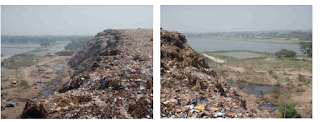
Kolkata: About 30,000 people live on and around Kolkata’s
landfill site at Dhapa. Garbage collectors clean up around 4.5 million people
and dump around 4000 metric tonnes of waste at Dhapa site. In the foot of large
garbage mountains, there is a slum where thousands of
rag pickers or scrap dealers live
and earn by sorting the wastes and recycling them accordingly. Near to this place,
there
is a cremation
centre, where many unidentified dead bodies – most of them corpses of hawkers
or street dwellers are burned. This creates long lasting and serious health
problems for the people seeking lively hood here, which the State and Central
Government successively ignore. It does not stop here, there is
inextinguishable fire burning due to the careless dumping of hazardous
chemicals which continuously causes air and land pollution.


Leachate Ponding at Dhapa Disposal Site
(Source: Globalmethane.org)


Mumbai : In order to combat the growing problem of plastic
menace in the state of Maharashtra, Government has imposed a ban on several
items made of plastic and thermocol (Polystyrene) dishes, cups, plates, glasses, spoons, straw, containers etc. Residents of
Mumbai have been given the time until June 23, to get rid from all kinds of
plastic items. The ban is implemented not only on the manufacture however also
on use, storage and distribution of the plastic items and materials.
Reportedly, Mumbai was producing about 700 metric tonnes of plastic wastes,
which resulted in the clogging of drains, polluting beaches and causing air
pollution due to the burning of the plastic garbage. The State Government took
a big step causing 1.84 crore people to dump plastic wastes.


Chennai: The case study data estimated that this city
produces around 25,940 tonnes of plastic wastes per day. The State Government
has strictly prohibited the littering of plastic and solid wastes carelessly,
they have been informed to hand over all the generated waste materials to the
respective agency for proper recycling, disposal and degradation of wastes
produced in the city. This systematic disposal of generated wastes will not
allow water logging and the burning of wastes can be avoided. This step has
added to the advantage of overcoming all the serious health problems of the
public associated with irresponsible dwelling of wastes in the city and
prevents land, water, and air pollution too to a large extent.


What we are to do?


1.     The cities should promote better
holistic solid waste management systems by
investing in sustainable disposal
infrastructure, improving waste collection systems.


2.     The communities should be educated
in using recycled plastic as filler for cement blocks, ropes, and household
goods such as baskets and mats.


3.     Cities should encourage more
plastic recycling industries so that the recycling and reusing of the plastic
materials in a faster pace.


4.     Proper collection and disposal
systems are in place of different cities, which are necessary to ensure all
waste is managed in an environmentally sound manner.


5.     Different eco friendly plastic
handling policies should be implemented and followed in different metropolitan
cities in India.


References

Downtoearth.org.in

Globalmethane.org